The A+ School
The Office of Civil Defense
1966

“Protection of our school children is of vital concern since approximately one quarter of the population now attends school for a considerable portion of the day. Many new schools are being built, particularly in suburban areas, where the Nation Fallout Shelter Survey has indicated a shortage of available shelter spaces in existing buildings.” This lack of public fallout shelters outside of urban areas presented a continual problem for American civil defense planners who undertook many initiatives to promote construction of buildings with adequate fallout protection in the often newly-platted suburban neighborhoods where much of a
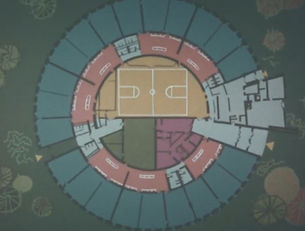
city’s daytime population resided. The above-quoted passage opens a fifty-seven page pamphlet descriptively titled Schools Built with Fallout Shelter. Published by the Office of Civil Defense in February of 1966, it features fifteen new schools across the United States where fallout shelters were purposefully incorporated into the design. Photographs and architectural sketches accompany each school profile, along with cost details and descriptions of the multipurpose uses of each unique shelter area. A wide array of locations are shown, from underground rooms in Texas’ Tornado Alley, to single story structures on the plains of Illinois, to multi-floored schools in heart of Brooklyn. The first school featured in pamphlet is South Salem Elementary in Salem, Virginia. Opened in 1965 at a cost of $437,400, the ring-shaped structure contained 6,300 feet of sheltered space in an inner hallway, included at a cost of .16 cents per square foot. In June of 1966, the Office of Civil Defense would release a short film titled The A+ School which documents the story of South Salem Elementary and the decision to make it a public fallout shelter.



The film opens with a mix of animated school artwork and live-action shots of children playing at recess. A score consisting of carnival music and children’s excited cries churns slowly in the background. When the camera offers a panoramic shot of the schoolyard, it is clear the stone and masonry building is situated on the outer edge of a suburban development, surrounded mostly by bare land. A voice-over narrator explain, with an inflection that is as folksy as it is authoritative, that in new neighborhoods, the school is often the most substantially constructed building. Th narration is provided by Lorne Green, star of the massively popular television series Bonanza. Green’s participation
in the film provides a jolt of star power for the Office of Civil Defense, as by 1966, Bonanza was entering its seventh season and its third year as the number one show in America.


With a runtime of only 6 1/2 minutes, the film is short, even by the standards of its genre. Like many civil defense films from the mid-1960s, The A+ School works hard to dispel the myth that a fallout shelter must be a single-purpose room located underground. Instead, Greene explains, that every three classrooms in South Salem Elementary are connected by a shared hallway which functions as an access corridor, a student work station, and a cloakroom. This segmented hallway runs in a full circle around the school's inner core which contains the gymnasium, cafeteria, library and offices. Thick masonry walls spread throughout the hallway
and on the exterior of the building, along with minimal classroom windows and a 6 1/2 inch concrete slab roof ensure the space provides provides adequate fallout protection for the school's entire population and an additional 180 people. This "Added Plus" of fallout protection is achieved through "Slanting", the architectural process of adjusting standard designs to include baffled doors and windows and thicker building materials for more shielding. The ultimate goal of slanting is to maintain the desired function and aesthetics of a building while creating fallout shelter spaces. Here, Greene stresses the children are comfortable in the shelter area, referenced onscreen with scenes of students gathered around tables in the protected hallway, happily working on the art projects featured in the opening sequence. Greene concludes by noting that while the first purpose of a school is to be "a practical and efficient center for learning" parents, staff and school board members must take the extra step to ensure their schools fallout shelters. Why? "There are as many reasons as there are children." The A+ School was not deemed obsolete at the end of the decade, but could instead be rented or purchased from government film catalogs into the 1970's. Likewise, South Salem Elementary School would serve its community for 60 years, ultimately being demolished in 2024 and replaced by a new school building.
The A+ School may be viewed, in its entirety, HERE.
References:
1. Office of Civil Defense. Schools Built with Fallout Shelter. U.S. Government Printing Office. February 1966.
2. Smith, Edward, P. “Idol” worship echoes to 1966 “Bonanza” was pop-culture icon. The Denver Post. March 11, 2006.
3. Department of the Army. Index of Motion Pictures and Related Audio-Visual Aids, 1977. 347.